Psychopathology of Everyday Life by Sigmund Freud

Want To Study Psychology?

The Psychopathology of Everyday Life is arguably one of Sigmund Freud's least technical and, therefore, most accessible publications. Drawing on personal anecdotes and real life examples, Freud explores the psychological mechanisms underpinning such things as the forgetting of names and order of words, mistakes in speech and mistakes in reading and writing etc.
Originally published in 1901, this work by Sigmund Freud was first translated into English by A.A Brill in 1914, who in his introduction provides a clear and concise account of the thinking behind the Psychopathology of Everyday Life.
|
Psychoanalysis always showed that they referred to some definite problem or conflict of the person concerned. It was while tracing back the abnormal to the normal state that Professor Freud found how faint the line of demarcation was between the normal and neurotic person, and that the psychopathologic mechanisms so glaringly observed in the psychoneuroses and psychoses could usually be demonstrated in a lesser degree in normal persons. This led to a study of the faulty actions of everyday life and later to the publication of the Psychopathology of Everyday Life. |
Find A Psychology School Near You
|
The Freudian Slip
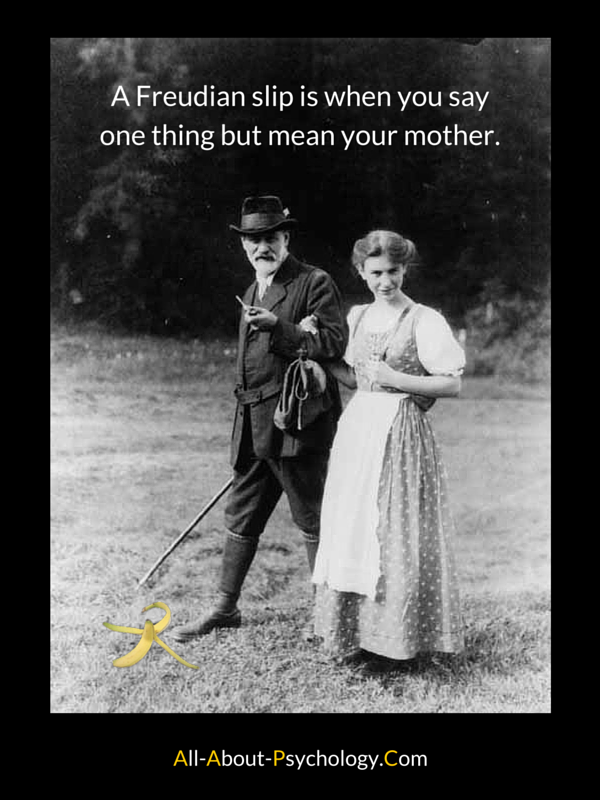
This was the book that gave rise to what we now refer to as "The Freudian slip". As Freud notes in the Psychopathology of Everyday Life:
Although the ordinary material of speech of our mother-tongue seems to be guarded against forgetting, its application, however, more often succumbs to another disturbance which is familiar to us as slips of the tongue.
 |
 |
You can download a free full-text PDF of this classic publication by Sigmund Freud via the following link.
Psychopathology of Everyday Life
Recent Articles


-
How to Stay Calm When Everything Changes
Sep 15, 26 09:11 AM
 Uncertainty and sudden life changes don’t have to trigger constant anxiety. Learn simple habits to release control and stay calm through transitions.
 -
What Is Autistic Inertia?
Sep 14, 26 11:38 AM
 A prominent sign of autism, getting stuck on something, now has an official name: “autism inertia.” Discover types, signs, and tips in the article.
 -
Introvert Personality and the 4 Types of Introverts Explained
Sep 12, 26 11:51 AM
 Explore introvert personality through the four STAR domains: social, thinking, anxious and restrained, including how they differ and overlap.
Download More Free Full-Text Psychology Classics