Thinking About Studying Psychology Online?
Explore online psychology degree options, including program types, accreditation, costs, career pathways and what to check before choosing a course.
Read The Online Psychology Degree GuideCarl Rogers
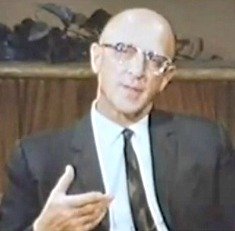
(Jan 8, 1902 - Feb 4, 1987)
One of the most eminent psychologists of the 20th century, Carl Rogers was profoundly influential in the humanistic movement towards person centered theory and non-directive psychotherapy. A prolific writer, 'Client-Centered Therapy' (1951), 'On Becoming a Person' (1961) and 'A Way of Being' (1980) rank among his most important published work.
In the course of a remarkable career spanning six decades, Rogers served as president of the American Psychological Association (APA) in 1947, received the APA Award for Distinguished Scientific Contributions in 1956, was named humanist of the year in 1964 and shortly before his death on February 4th 1987 was nominated for the Nobel Peace Prize.
Life and Legacy
For over 25 years Professor Howard Kirschenbaum from the University of Rochester has been interpreting and researching the life and work of Carl Rogers. In 2007 to mark the 20th anniversary of his death, Professor Kirschenbaum discussed the life and legacy of Rogers with Dr Raj Persaud as part of the BBC radio series All in The Mind. The broadcast included an extract from an interview Rogers gave in 1978, from which I've highlighted the following quote as it provides a clear and concise insight in to the person/client centered approach To psychotherapy. Rogers stated:
"We regard the medical model as an extremely inappropriate model for dealing with psychological disturbances. The model that makes more sense is a growth model or a developmental model. In other words we see people as having a potential for growth and development and that can be released under the right psychological climate. We don't see them as sick and needing a diagnosis, a prescription and a cure; and that is a very fundamental difference with a good many implications."

Watch Carl Rogers Conducting Client Centered Therapy
The following five-part video playlist was part of a groundbreaking production from 1965 Entitled "Three Approaches to Psychotherapy" featuring Carl Rogers in session with Gloria, a 30-year-old divorcee.
Essential Reading

Originally published in 1946 as an article, Significant Aspects of Client-Centered Therapy is essential reading for anybody interested in psychotherapy and counseling. In this landmark publication Carl Rogers outlines the origins of client-centered therapy, the process of client-centered therapy, the discovery and capacity of the client and the client-centered nature of the therapeutic relationship.
Bonus Content
Significant Aspects of Client-Centered Therapy builds upon some of Carl Rogers' previously published work. Among the most notable of these earlier articles were 'The Processes of Therapy' and 'The Development of Insight in A Counseling Relationship;' both of which are also presented in full. You can get hold of Significant Aspects of Client-Centered Therapy on Amazon (kindle and paperback) via the following link.
Significant Aspects of Client-Centered Therapy

Recent Articles


-
Perfectionism: What it is, why it hurts, and how to manage it
Oct 04, 26 11:56 AM
 Explore the psychology of perfectionism, how it differs from healthy high standards, and research-informed ways to reduce its impact on your life.
 -
Psychology Expert Interview | Get Featured on All About Psychology
Sep 24, 26 02:14 PM
 Get featured on All About Psychology with a professionally prepared expert interview, website publication, newsletter exposure and social promotion.
 -
How to stop overthinking and break the cycle
Sep 24, 26 02:04 PM
 Learn how to stop overthinking, handle repetitive thoughts, ease self-criticism, and make decisions without getting stuck in endless analysis.
Please help support this website by visiting the All About Psychology Amazon Store to check out an awesome collection of psychology books, gifts and T-shirts.
 |
 |


Know someone interested in Carl Rogers?
Share this page with them.
Go To The Psychology Pioneers Page
Go From Carl Rogers Back To The Home Page