Online Bachelor’s Degree in Psychology
By David Webb, Founder and Editor of All-About-Psychology.com
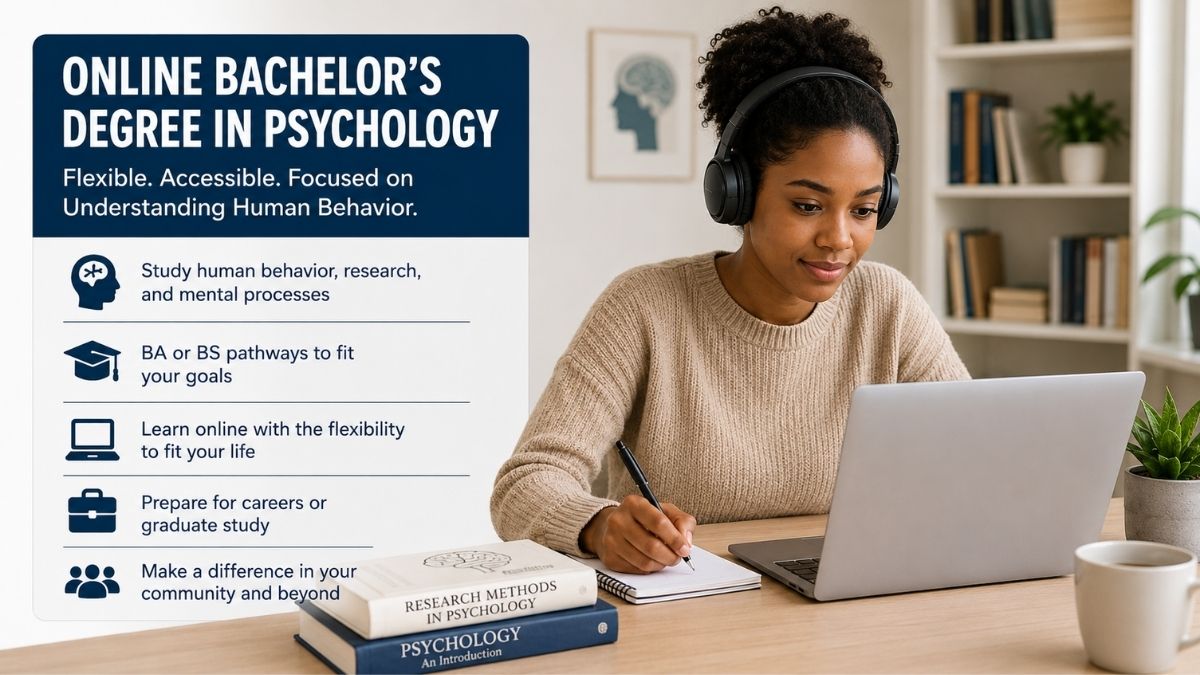 Online study can offer a flexible route into psychology for students balancing education with work, family or other commitments.
An online bachelor’s degree in psychology is an undergraduate route into the study of human behavior, mental processes, research and data-based thinking. It is often chosen by students who want a structured psychology degree while studying around work, family, military service, existing college credits or other commitments.
This page focuses specifically on bachelor’s-level psychology study. If you are looking for a broader overview of online psychology degrees at different levels, including associate, master’s and doctoral options, see the online psychology degree guide.
Here, the focus is on the undergraduate decision: what an online bachelor’s degree in psychology involves, how BA and BS options differ, what to check before applying, what career paths may be realistic after graduation and when further graduate study is likely to be needed.
What is an online bachelor’s degree in psychology?
An online bachelor’s degree in psychology is a four-year undergraduate program that introduces students to the scientific study of behavior, thought, emotion, development and social interaction. It is usually the first full degree-level step for students who want to study psychology seriously, whether they plan to enter the workforce after graduation or continue into graduate study later.
The online format means that most or all teaching is delivered through a digital learning platform. Some programs are mainly asynchronous, allowing students to complete weekly coursework around their schedule. Others include live online classes, group projects, virtual office hours or occasional in-person requirements.
At bachelor’s level, the aim is to build a broad academic foundation. Students are not being trained for independent clinical practice at this stage. Instead, they are learning the core concepts, research skills and analytical habits that can support psychology-related work, further education or graduate-level professional training.
Who is an online bachelor’s degree in psychology suitable for?
An online bachelor’s degree in psychology may suit students who want an undergraduate psychology degree but cannot easily attend a campus-based program. This can include people balancing study with employment, family responsibilities, military service, caregiving or existing college credits.
It may also appeal to career changers who want a formal academic foundation in psychology before deciding whether to pursue graduate study or move into a people-focused field. However, online study is not automatically easier than campus study. Students still need to manage deadlines, complete reading and writing assignments, engage with faculty and develop the self-discipline required for independent learning.
| May be a good fit if you... | May not be the right fit if you... |
|---|---|
| Need to study around work, family, caregiving or military commitments. | Need frequent in-person contact, campus facilities or face-to-face study support. |
| Have previous college credits and want to complete a bachelor’s degree online. | Have not yet checked whether your previous credits are likely to transfer. |
| Want a foundation for graduate study in psychology, counseling, social work, education or a related field. | Want a degree that qualifies you immediately for independent clinical practice. |
| Are comfortable with reading, writing, online discussion, statistics and self-directed study. | Prefer a highly structured campus routine with regular in-person classes. |
BA vs BS in psychology
Many online psychology bachelor’s programs are offered as either a Bachelor of Arts (BA) or a Bachelor of Science (BS). Both can be legitimate routes into the psychology major. The better choice depends on the curriculum, your academic strengths and what you may want to do after graduation.
A BA in psychology usually has a broader liberal arts focus. It may leave more room for electives, humanities, communication, social science courses or a minor in another subject. A BS in psychology usually has a stronger science and research focus, with more emphasis on statistics, research design, biological science, neuroscience or lab-based coursework.
| Feature | BA in Psychology | BS in Psychology |
|---|---|---|
| Typical focus | Broader liberal arts, humanities and social science emphasis. | Stronger science, research and quantitative emphasis. |
| Course balance | May offer more elective flexibility and room for a minor or second area of interest. | May include more statistics, research methods, biology, neuroscience or lab-related requirements. |
| Often suits students interested in... | Human services, education, communication, business, advocacy or broad people-focused careers. | Research, data analysis, neuroscience, health-related pathways or graduate study with a stronger science base. |
| Main question to ask | Does the program give me enough flexibility for my career or graduate-school plans? | Does the program give me enough research, statistics and science preparation for my goals? |
In practice, the letters BA or BS matter less than the actual courses you take. Before choosing, compare the curriculum carefully. Look at the statistics requirement, research methods requirement, elective options, faculty support, transfer credit policy and whether the program fits your likely career or graduate-school pathway.
What do you study in an online psychology bachelor’s degree?
An online psychology bachelor’s degree usually combines core psychology knowledge with research training, statistics, writing and critical thinking. At undergraduate level, the aim is to help students understand psychological science and develop skills that can support employment, further study or later professional training.
When comparing programs, it is useful to look beyond the course titles and ask what the curriculum is actually helping you build.
| Curriculum area | What to look for | Why it matters |
|---|---|---|
| Psychology foundations | Courses that introduce major areas of psychology, including behavior, development, cognition, mental health and social interaction. | Gives students the broad academic base needed before choosing a more specific career or graduate-study direction. |
| Research and statistics | A clear requirement for research methods, statistics and evidence evaluation. | Helps students understand how psychological knowledge is produced, tested and interpreted. |
| Ethics and academic reasoning | Content on ethical issues, responsible use of evidence, cultural context and professional standards. | Prepares students to think carefully about how psychological knowledge is used in research, work and society. |
| Applied and transferable skills | Writing, communication, information literacy, data interpretation, problem-solving and understanding people in context. | Makes the degree useful beyond psychology-specific roles, especially in people-focused fields. |
| Capstone or practical experience | A final project, portfolio, internship, supervised experience or structured opportunity to apply what has been learned. | Can help online students demonstrate readiness for employment or strengthen a later graduate-school application. |
Before applying, check whether the program clearly explains its course sequence, learning outcomes, assessment methods and opportunities for faculty contact. These details can matter as much as the course titles themselves, especially if you plan to apply for graduate study later.
Online vs campus psychology study
At bachelor’s level, online and campus psychology programs may cover many of the same academic subjects. The main difference is not necessarily what students study, but how they access teaching, interact with faculty and classmates, and build experience outside regular coursework.
| Area to compare | Online bachelor’s study | Campus bachelor’s study |
|---|---|---|
| Schedule | May offer asynchronous coursework, making it easier to study around other responsibilities. | Usually follows a more fixed class timetable. |
| Faculty contact | Often depends on email, video calls, online office hours and scheduled advising. | May allow more informal face-to-face contact before or after class. |
| Peer connection | Usually built through discussion boards, group projects, virtual clubs or online study groups. | May develop through in-person classes, societies, labs and campus events. |
| Research or practical experience | May require extra initiative to find research opportunities, local placements, capstones or faculty-led projects. | May offer easier access to campus labs, research assistant roles or local partner organizations. |
The online route can work very well for students who are organized, self-directed and willing to communicate actively with instructors. Before applying, check how the program supports online students academically, socially and professionally, not just whether the classes are available online.
Accreditation and transfer credits
Accreditation is one of the most important things to check before applying to an online bachelor’s degree in psychology. At undergraduate level, the key issue is usually whether the college or university itself holds recognized institutional accreditation. This can affect financial aid eligibility, transfer credits, graduate school applications and how the degree is viewed by employers.
Students should also be careful with claims about “APA-accredited” bachelor’s programs. The American Psychological Association Commission on Accreditation does not accredit bachelor’s degrees in psychology. APA accreditation is mainly relevant to doctoral programs, internships, postdoctoral residencies and some professional specialty areas, not undergraduate psychology majors.
Important accreditation point
For an online bachelor’s degree in psychology, focus first on whether the institution is properly accredited. Do not assume that a bachelor’s program can or should be APA-accredited.
Transfer credits also need careful checking. Even when a previous course was taken at an accredited institution, the receiving college decides whether to accept it, how many credits to award and whether those credits count toward general education, psychology major requirements or electives.
Before enrolling, ask the admissions office for a written transfer credit evaluation if you have previous college credits. This is especially important for transfer students because accepted credits can reduce the time and cost needed to complete the bachelor’s degree.
Can you become a psychologist or therapist with a bachelor’s degree?
A bachelor’s degree in psychology can be an important first step, but it does not normally qualify someone to work independently as a psychologist, therapist or counselor. These are regulated professional roles, and independent practice usually requires graduate-level education, supervised professional experience, examinations and approval from a licensing board.
Important licensing point
An online bachelor’s degree in psychology may help prepare you for graduate study, but it should not be treated as a stand-alone qualification for becoming a licensed psychologist, therapist or counselor.
This distinction matters because many students are drawn to psychology because they want to help people directly. A bachelor’s degree can provide useful preparation for that longer pathway, but students should check the requirements for the specific profession and location where they eventually hope to work.
For example, someone interested in becoming a licensed psychologist will usually need doctoral-level training. Someone interested in counseling, therapy or clinical social work will usually need a relevant graduate degree and supervised practice. The exact requirements vary by state, country and profession.
What can you do with a bachelor’s degree in psychology?
A bachelor’s degree in psychology can support a range of entry-level and early-career opportunities, especially in roles that involve communication, research, data interpretation, human behavior, support services or working with people. However, graduates should be realistic. A psychology bachelor’s degree is versatile, but it does not automatically lead to a licensed psychology career.
Many graduates use their psychology background in fields where understanding people, behavior, motivation, evidence and communication is valuable.
| Career area | Example roles | How psychology can help |
|---|---|---|
| Human services and community support | Case manager, community support worker, youth advocate, social services assistant. | Understanding behavior, communication, development, mental health concepts and support needs. |
| Behavioral health support | Behavioral health technician, psychiatric technician, crisis support assistant, residential support worker. | Applying basic knowledge of behavior, boundaries, observation, record keeping and supervised support. |
| Human resources and training | HR assistant, recruiter, training coordinator, employee support role. | Using knowledge of motivation, group behavior, communication, assessment and workplace relationships. |
| Research and data support | Research assistant, survey assistant, data collection assistant, program evaluation support. | Using research methods, statistics, evidence evaluation and clear reporting skills. |
| Business, marketing and user research | Market research assistant, customer insight role, user research support, communications assistant. | Understanding decision-making, attitudes, behavior, survey design and consumer motivation. |
| Criminal justice and advocacy | Victim advocate, probation support role, corrections support worker, rehabilitation program assistant. | Applying knowledge of behavior, social influence, risk factors, communication and support systems. |
Job titles, salaries and entry requirements vary widely, so students should check current listings in their area and look carefully at what employers actually require. In many cases, experience, internships, volunteering, data skills, writing ability and references can be just as important as the degree title itself.
Preparing for graduate study
For many students, a bachelor’s degree in psychology is not the final destination. It is the undergraduate foundation for possible graduate study in psychology, counseling, social work, education, research or another related field.
Online students can prepare well for graduate school, but they may need to be more deliberate about building the experiences and relationships that campus students sometimes find more easily through in-person contact.
Graduate school preparation checklist
- Choose a program with strong courses in statistics, research methods and writing.
- Look for opportunities to complete a capstone, research project, internship or supervised experience.
- Use virtual office hours and advising sessions to build genuine faculty relationships.
- Ask whether online students can join research projects, psychology clubs, honor societies or student groups.
- Keep examples of strong academic work, especially research papers, data projects or applied assignments.
- Check the entry requirements for any graduate programs you may want to apply to later.
This matters because graduate programs often look beyond the degree title. They may consider grades, prerequisite courses, research experience, writing ability, recommendations, relevant work or volunteer experience and how clearly the applicant understands the field.
If graduate study is one of your goals, compare online bachelor’s programs with that pathway in mind from the beginning. The strongest option is not always the quickest or cheapest program, but the one that gives you the academic preparation and support needed for your next step.
Costs and questions to ask before applying
The cost of an online bachelor’s degree in psychology can vary widely. Public universities, private colleges, residency rules, transfer credits, financial aid and online course fees can all affect the final price. For transfer students, accepted credits may also reduce the time and money needed to finish the degree.
Before applying, look beyond the headline tuition rate. A lower-cost program may not be the best value if it offers weak student support, limited faculty access or poor transfer credit policies. A more expensive program also does not automatically lead to better outcomes.
Questions to ask before choosing a program
- Is the college or university institutionally accredited?
- What is the total estimated cost, including tuition, fees, books, software and technology charges?
- If you have previous college credits, will the school provide a written transfer credit evaluation?
- Are courses asynchronous, live online, hybrid or a mixture of formats?
- Does the curriculum include research methods, statistics, writing and ethical reasoning?
- Are online students able to access academic advising, faculty office hours and career support?
- Are there capstone, internship, portfolio or research opportunities?
- How well does the program fit your likely career goal or graduate-school pathway?
Students in the United States can also use the U.S. Department of Education College Scorecard to compare information such as costs, graduation rates and earnings data. These figures should not be treated as guarantees, but they can help students ask better questions before enrolling.
For a wider overview of online psychology degree options at different levels, see the online psychology degree guide.
Online bachelor’s degree in psychology FAQ
Is an online bachelor’s degree in psychology worth it?
An online bachelor’s degree in psychology can be worth it if the program is properly accredited, affordable, well supported and aligned with your goals. It may be especially useful for students who need flexibility or who already have transfer credits. However, the degree should be evaluated carefully in terms of total cost, curriculum quality, faculty access, transfer credit policy and likely career or graduate-study pathway.
Is a BA or BS better for psychology?
Neither a BA nor a BS in psychology is automatically better. A BA may offer more flexibility, broader liberal arts study and room for electives or a minor. A BS may offer more science, statistics, research or neuroscience preparation. The better choice depends on the actual curriculum and how well it fits your future plans.
Can I become a therapist with a bachelor’s degree in psychology?
A bachelor’s degree in psychology does not normally qualify someone to work independently as a therapist, counselor or psychologist. These roles usually require graduate-level education, supervised professional experience, examinations and licensing approval. A bachelor’s degree can be a useful first step, but it is not usually the final professional qualification.
Can an online bachelor’s in psychology prepare me for graduate school?
Yes, it can, provided the program includes strong preparation in research methods, statistics, writing and core psychology content. Students who plan to apply for graduate school should also look for faculty access, advising, research opportunities, capstone projects, internships or other ways to build a stronger application.
Is APA accreditation important for a bachelor’s degree in psychology?
APA accreditation does not apply to bachelor’s degrees in psychology. At undergraduate level, students should focus first on whether the college or university holds recognized institutional accreditation. APA accreditation is mainly relevant to doctoral training, internships, postdoctoral residencies and some professional specialty areas.
What should I check before applying?
Before applying, check accreditation, total cost, transfer credit policy, course format, curriculum, learning outcomes, assessment methods, faculty support, advising, career services and any practical or in-person requirements. For a broader overview of online psychology degree options at different levels, see the online psychology degree guide.
An online bachelor’s degree in psychology can be a useful and flexible way to study human behavior at undergraduate level. The strongest choice is not simply the quickest or cheapest program, but the one that offers recognized accreditation, a suitable curriculum, clear support for online students and a realistic fit with your career or graduate-study plans.
Important note
Program availability, accreditation, transfer credit policies, costs, career outcomes and licensure requirements vary by school, location and profession. Always confirm details directly with the institution and, where relevant, the licensing board or professional regulator for the place where you plan to work.