The Nihilist Penguin: Origin, Meaning, and Psychology
By David Webb, Founder and Editor of All-About-Psychology.com
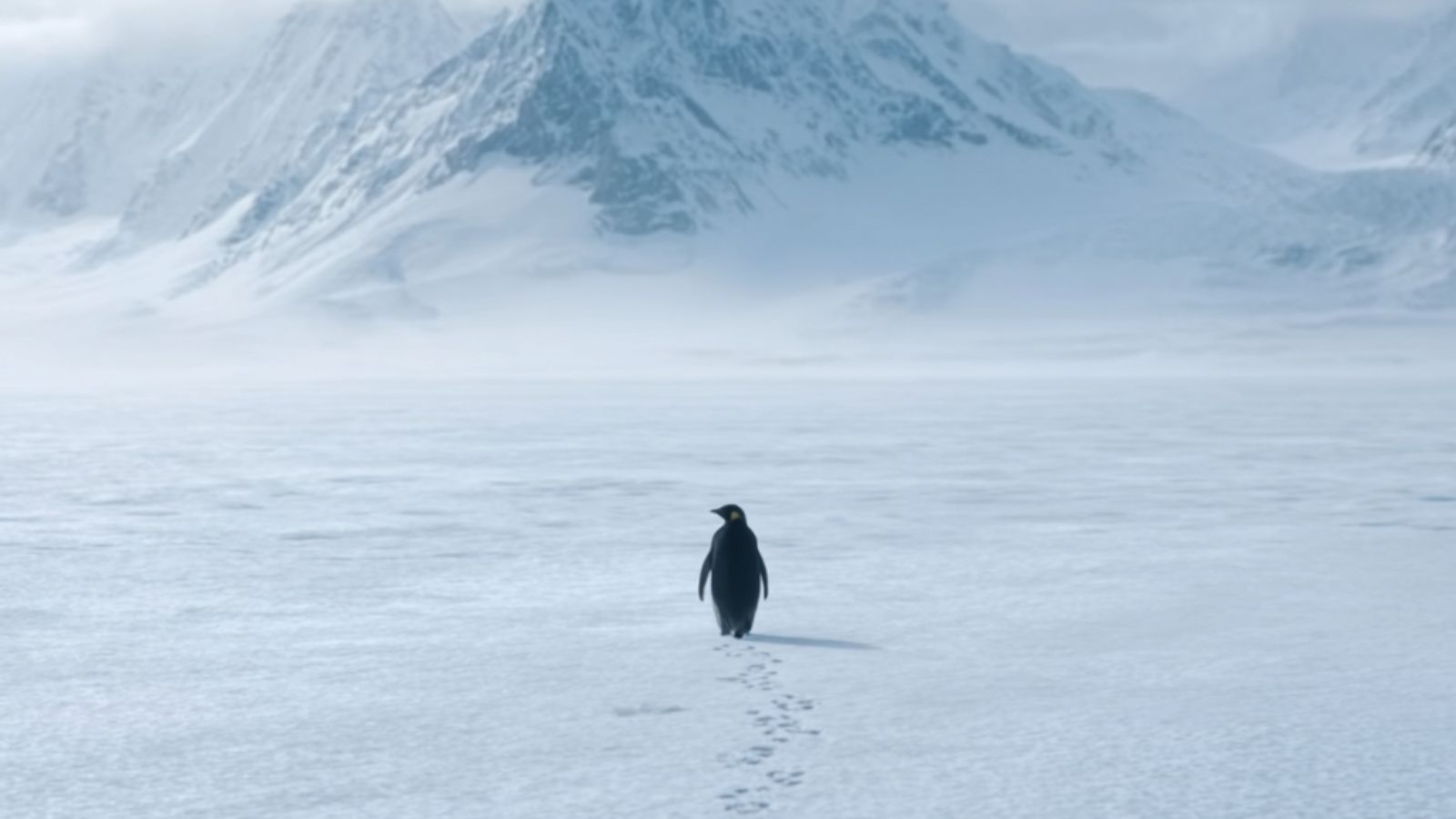 The viral “nihilist penguin” image captures the moment many viewers interpret as walking away, although the original documentary presents the scene as a lost penguin moving in the wrong direction.
What Is The Nihilist Penguin?
The “nihilist penguin” refers to a viral clip from Werner Herzog’s 2007 documentary Encounters at the End of the World, in which a lone penguin walks away from its colony and heads inland toward the mountains instead of moving toward the sea.
In the original documentary, the moment is presented as an example of disorientation rather than a conscious act of despair or rebellion. Marine ecologist David Ainley explains that penguins sometimes become disoriented and end up far from where they should be. Herzog then describes the penguin heading toward mountains roughly seventy kilometers away, before asking the question that gives the scene much of its power: “But why?”
Nearly two decades later, the clip began circulating online as the “nihilist penguin.” Viewers have used it to express ideas about exhaustion, withdrawal, refusal, alienation, and the urge to walk away from the expected path. The penguin itself may simply be lost, but the meme has become a striking example of how people project human meaning onto ambiguous animal behavior.
Key takeaway: The “nihilist penguin” is not proof of a penguin choosing despair. It is a viral reinterpretation of documentary footage in which a lone penguin moves away from its colony and appears to head in the wrong direction. Its power comes from the way viewers turn ambiguous animal behavior into a human story about exhaustion, withdrawal, and meaning.
Where Did The Nihilist Penguin Clip Come From?
I first came across the “nihilist penguin” video after my son Paolo asked me if I’d seen it. He thought it would make a good topic for an article, and he was right.
The original footage comes from Werner Herzog’s 2007 documentary Encounters at the End of the World, a film about Antarctica and the people who live and work there. In the scene, Herzog asks marine ecologist David Ainley whether there is such a thing as insanity among penguins.
Ainley says he’s never seen anything like a penguin deliberately bashing its head against a rock, but he explains that penguins can become disoriented and end up in places they shouldn’t be, far from the ocean.
The film then cuts to a colony of penguins moving toward open water. One penguin, however, does something different. It doesn’t follow the group toward the feeding grounds, and it doesn’t return to the colony. Instead, it walks inland, heading toward the mountains some seventy kilometers away.
Herzog notes that, according to Ainley, even if the penguin were caught and returned to the colony, it would turn around and head back toward the mountains. Herzog then asks the question that has helped make the clip so memorable:
But why?
Before moving into the meme version of the clip, it’s worth watching the original documentary scene and noticing what you think is happening.
The original documentary clip is important because it shows the scene before later captions, edits, and commentary turned the penguin into a viral symbol.
Repurposing The Clip
What made the “nihilist penguin” spread online wasn’t only the original footage. It was the way the clip was repurposed. Once removed from the documentary and placed into a social media context, the penguin’s strange movement became easier to read as something more human: despair, defiance, exhaustion, refusal, or the desire to leave everything behind.
This is where the psychology becomes interesting. The penguin doesn’t need to be thinking any of those things for viewers to feel that it is. The clip works because it gives people just enough ambiguity to project meaning onto it.
This is the repurposed version my son sent me. Notice how the added music, captions, and commentary change the emotional meaning of the original footage.
The repurposed clip shows how quickly a documentary moment can become a cultural metaphor when sound, captions, and online commentary reshape what viewers think they are seeing.
What Does The Nihilist Penguin Mean?
Once the scene began circulating online, the penguin was no longer just an animal moving in an unexpected direction. It became a symbol people could use to express something recognisably human.
In many versions of the meme, the emphasis falls less on confusion and more on departure. The penguin appears to turn away from the crowd, from the expected route, and from the path it is supposed to follow.
That is why viewers attach ideas to it such as exhaustion, refusal, alienation, and the desire to stop playing along. The penguin becomes a shorthand for the feeling of being done with expectations that no longer seem meaningful.
But this is a human interpretation, not a fact about the penguin’s inner life. The original footage does not show philosophical despair, protest, or rebellion. It shows a penguin heading the wrong way.
That distinction is what makes the nihilist penguin so psychologically interesting. The power of the meme comes from the gap between what is actually shown and what people feel invited to see.
Why Intention Is So Compelling
There’s a simple reason the interpretation changes so quickly from disorientation to intention: confusion is unsatisfying.
An animal that has simply gone the wrong way doesn’t give us much to hold on to. It doesn’t explain anything, resolve anything, or point toward a larger story. It leaves us with accident, randomness, and a kind of emotional dead end.
Intention, by contrast, gives the scene shape. A decision implies agency. Agency implies meaning. Once the penguin’s movement is framed as chosen rather than mistaken, it becomes something people can relate to, narrate, and share.
This is why captions, music, and added commentary are so effective. They don’t just decorate the footage. They make it feel more coherent. They turn uncertainty into a story, and a strange movement across the ice into something that appears emotionally legible.
That shift says far less about the penguin than it does about human psychology. We are often more comfortable with purposeful withdrawal than with purposeless error.
The appeal of the “nihilist penguin” is not simply that it seems bleak or detached. It is that the meme turns those feelings into something that looks like a choice.
What The Clip Does Not Prove
The “nihilist penguin” label is powerful, but it can also mislead. It turns a striking visual moment into a claim about motive, when the footage itself cannot tell us what the animal is experiencing.
That matters because the meme often works by making interpretation feel like evidence. The penguin looks as if it is rejecting the group, so the rejection starts to feel real. It looks as if it has chosen a path, so the choice starts to feel obvious.
But the clip does not give us access to the penguin’s inner world. It gives us movement, distance, isolation, and direction. The rest is supplied by the viewer.
This is why the scene is so effective online. It doesn’t need to prove the interpretation. It only needs to make the interpretation feel instantly recognizable.
Once that distinction is clear, the better question is not whether the penguin is really a nihilist. It’s why this particular image makes that reading feel so natural.
Why Is It Called The Nihilist Penguin?
The word nihilist matters because it gives the meme a philosophical edge. Without that label, the scene might simply look strange, sad, or darkly funny. With it, the penguin becomes tied to questions about meaning, purpose, and whether the expected path still makes sense.
Nihilism is often used loosely online to suggest a loss of meaning or a refusal to pretend that things matter in the usual way. That is why the label fits the mood of the meme, even if it does not accurately describe the animal itself.
When viewers call it the “nihilist penguin,” they are not usually making a precise philosophical argument. They are using the image to express a feeling: the sense that continuing in the accepted direction may no longer feel worthwhile.
This is also why related ideas such as absurdism and existentialism tend to appear around the meme. The penguin’s movement seems to raise the kind of question people associate with those traditions: what do we do when the path in front of us no longer offers a clear sense of meaning?
That doesn’t mean the clip has one fixed interpretation. For some people, it looks bleak. For others, it looks strangely resolute. The same image can suggest giving up, opting out, or refusing to keep moving with the crowd.
The phrase “nihilist penguin” works because it compresses all of that ambiguity into two words. It turns a brief visual moment into a symbol for the uneasy space between meaninglessness and self-direction.
The Appeal Of Stepping Out Of Line
Part of the appeal of the “nihilist penguin” is that it maps so easily onto ordinary experience. Most people are not walking across Antarctic ice, but many know what it feels like to be pulled along by a route they did not consciously choose.
Modern life often asks for constant participation. People are expected to respond, perform, update, improve, and remain available, often without much time to ask whether all that activity is leading anywhere worthwhile.
Work can follow people home through emails, notifications, unfinished tasks, and the quiet pressure to stay reachable. Progress is often measured through targets, dashboards, metrics, and engagement numbers rather than judgment, trust, or genuine satisfaction.
In that context, the penguin’s change of direction becomes easy to understand as a metaphor. It seems to capture a private feeling many people recognize but may not say out loud: the sense of wanting to step outside a pattern that has started to feel automatic.
The meme doesn’t offer a solution. It doesn’t explain what should happen next. Its appeal lies in the fact that, for a moment, it gives visible form to the wish to stop moving with the crowd and question the direction everyone else appears to be taking.
Sitting With The Question
One reason the “nihilist penguin” clip lingers is that Werner Herzog doesn’t explain it away. He gives us the scene, offers the biological context, and then leaves the central question suspended:
But why?
That unanswered question is part of the clip’s force. A neat explanation would make the moment smaller. It would turn the penguin into a simple case of animal disorientation and leave very little room for interpretation.
Instead, the image remains open. The penguin keeps moving across the ice, and viewers are left with a strange mixture of fact and feeling. We know enough to understand that the animal may simply be lost, but not enough to stop the scene from suggesting something larger.
That is why the “nihilist penguin” has become more than a passing meme. It gives people a way to think about conformity, uncertainty, fatigue, and the uneasy feeling of continuing through life without being entirely sure where all that movement is supposed to lead.
The penguin may not be making a statement. But the fact that so many people feel compelled to give it one tells us something important about the human need to find meaning in ambiguous moments.
Frequently Asked Questions About The Nihilist Penguin
What Is The Nihilist Penguin In Simple Terms?
In simple terms, the “nihilist penguin” is a viral name for a scene from Werner Herzog’s 2007 documentary Encounters at the End of the World, where a lone penguin moves away from its group and heads inland across the ice.
What Documentary Is The Nihilist Penguin From?
The clip comes from Encounters at the End of the World, Werner Herzog’s documentary about Antarctica and the people who live and work there.
Is The Nihilist Penguin Really Choosing Death?
No. The documentary does not show that the penguin is choosing death or making a conscious statement. The “nihilist” meaning comes from later online interpretation, not from evidence of the animal’s intent.
Why Did The Nihilist Penguin Become A Meme?
The scene became a meme because it is visually simple, emotionally ambiguous, and easy to reinterpret. A lone penguin moving away from the group can be read as a symbol of exhaustion, alienation, or stepping outside the expected route.
What Does The Nihilist Penguin Symbolize?
For many viewers, the nihilist penguin symbolizes the urge to stop following a direction that no longer feels meaningful. Psychologically, its power comes from the gap between what the footage shows and what viewers read into it.
Related Psychology Articles
If you found the psychology of the “nihilist penguin” interesting, these related articles explore how people find meaning, interpret experience, and respond to information.
- The Forer Effect: Why Vague Statements Can Feel Personally Meaningful
- Pareidolia: Why We See Meaningful Patterns In Random Things
- Cognitive Biases and Brain Biology: Why Facts Don’t Always Change Minds
- 10 Memes Psychology Students Will Love
This article is adapted from an original article first published on the All About Psychology Substack.
Want more psychology articles like this? Join 100,000+ psychology lovers exploring human behavior, psychological science, everyday experience, and what makes us think, feel, and act the way we do.