Thinking About Studying Psychology Online?
Explore online psychology degree options, including program types, accreditation, costs, career pathways and what to check before choosing a course.
Read The Online Psychology Degree Guide
Music and Memory: How Songs Become the Soundtrack of Our Lives

David Webb (Founder and Editor of All-About-Psychology.com)
For my birthday, my sons bought me a Spotify subscription, which means I now have a personal playlist of over seventy of my favorite songs. When I was compiling the playlist, I was reminded that although my main teaching area was forensic psychology, which I genuinely love, the area of psychology that fascinates me the most is music psychology.
My interest in the psychology of music was ignited when I came across a clip from Alive Inside: A Story of Music and Memory, a profoundly moving documentary that chronicles social worker Dan Cohen’s discovery that personalized music can awaken memories in people with Alzheimer’s and dementia.
During the making of the documentary, a clip of Henry, a 94-year-old man with dementia, was posted on YouTube. The clip went viral and has since been seen by over 8 million people.
The clip features the late neurologist Oliver Sacks, who spent much of his career documenting how deeply music is embedded in the brain. Reflecting on cases like Henry’s, Sacks wrote:
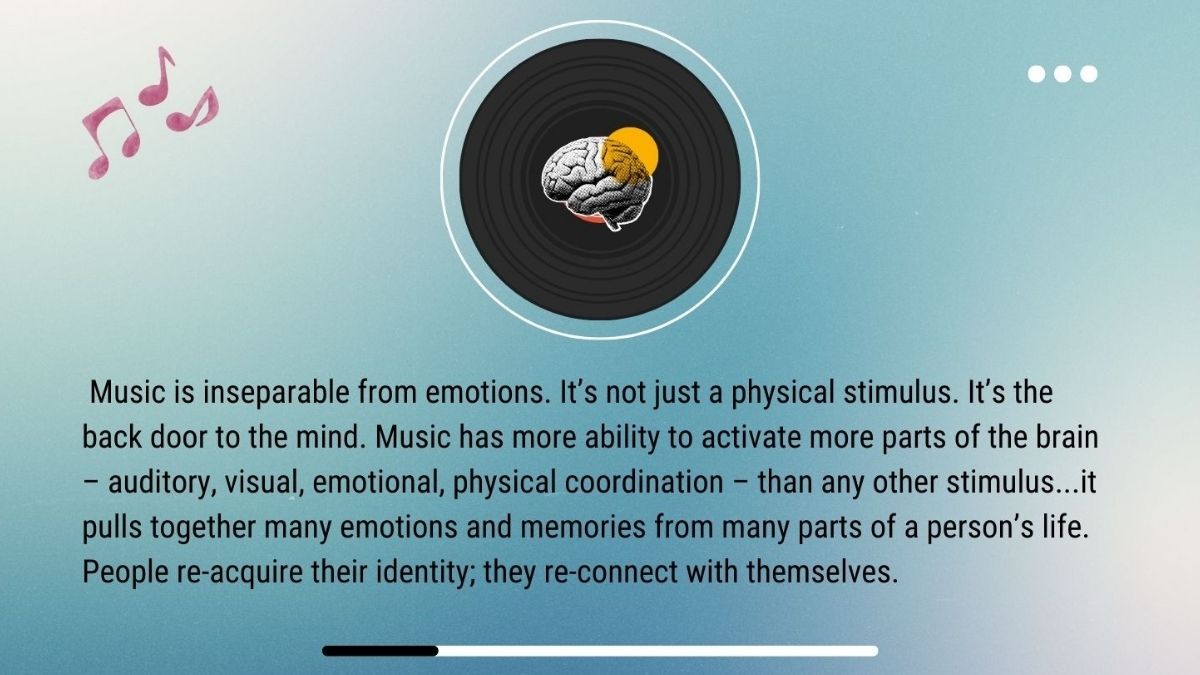
Music can lift us out of depression or move us to tears – it is a remedy, a tonic, orange juice for the ear. But for many of my neurological patients, music is even more – it can provide access, even when no medication can, to movement, to speech, to life. For them, music is not a luxury, but a necessity.
Music as Care, Music as Continuity
What Henry’s story makes hard to ignore is that music isn’t functioning as entertainment here. It’s functioning as care.
Across psychology and neuroscience, there’s growing agreement on this point. Music engages multiple brain systems at once: auditory processing, emotion, movement, memory, and attention. Because these systems are widely distributed, music can remain accessible even when other abilities decline. This is one reason researchers have found that musical memory is often preserved in people with Alzheimer’s disease and other forms of dementia.
Crucially, this isn’t about music in general. It’s about personal music. Songs that are tied to a person’s history, relationships, culture, and sense of self. Published research shows that individualized music interventions can reduce agitation, improve mood, and increase social engagement in people with dementia. In some cases, they also improve verbal responsiveness and orientation, at least temporarily.
What’s striking is why this works.
Music doesn’t rely on the same cognitive pathways as conversation or factual recall. It taps into emotional memory and procedural memory, systems that are closely linked to identity and often remain intact longer. When someone responds to a familiar song, they’re not retrieving isolated facts. They’re reconnecting with patterns of feeling, movement, and meaning that have been reinforced over decades.
This helps explain why the effects often persist beyond the moment of listening. Caregivers regularly report that people become more communicative, more expressive, and more socially present even after the music stops.
From a psychological perspective, this reframes what care looks like. Supporting someone with dementia isn’t only about managing decline. It’s also about preserving access to the parts of the self that are still very much alive. Music provides one of the most reliable routes to those parts.
There’s an ethical implication here too. If personalized music can restore connection, calm distress, and reinforce identity, then treating it as optional or recreational misses the point. For many people with dementia, music isn’t a pleasant extra. It’s one of the few remaining ways to feel like themselves.
And that brings us to continuity.
Henry doesn’t become someone new when the music starts. He becomes more fully who he has always been. The singing, the rhythm, the emotional response aren’t signs of recovery in the medical sense. They’re signs of access. Access to identity, to history, to a sense of being a person in the world.
Seen this way, music functions as a bridge. It connects past to present, emotion to memory, self to others. When language falters and attention fragments, music can still hold the pieces together.
That insight matters not just for how we care for people with dementia, but for how we understand ourselves. If music can preserve continuity under neurological damage, then it’s worth asking what role it plays in maintaining continuity across an ordinary life. How it shapes memory. How it marks time. How it quietly becomes part of who we are. Here’s another great insight by Oliver Sacks.
Life Story Playlist
I wanted to test Sacks’ contention that music pulls together many emotions and memories from many parts of a person’s life, so I set myself the challenge of whittling my playlist down to just ten songs that mean the most to me on an emotional level. I highly recommend doing this yourself. Just remember, this isn’t about the songs you like the best; it’s about the ones that provide a visceral reminder of life’s important moments.
Here’s my list:
This was a powerful exercise, particularly when reflecting on the song choices I made and why. Collectively, this playlist of just ten songs covers love, heartbreak, crushing disappointment, joy, euphoria, and friendship.
What this exercise reveals is that music doesn’t just remind us of isolated moments; it organizes our sense of who we’ve been, what we’ve longed for, and how those experiences continue to live inside us over time.
It’s also a wonderfully personal exercise. I guarantee that if you tried to match the emotion invoked by each song in somebody else’s list, you would definitely get some wrong.
I can also personally attest to the emotional pull of music rooted in a person’s life, and to its role as a back door to the mind. A chance re-listening to one of the songs on my list prompted me to write an entire article about it last year.
The Psychology of Playlists
Not every playlist is designed to change how we feel, and not every listener has a clear intention in mind when creating one. But psychologically, playlists often end up doing more than we realize.
When we create playlists, we’re not just grouping music. We’re making choices about what we want to hear, when, and in what order. Those choices are rarely random. Even when we don’t think of them this way, they reflect how we want to feel, or how we’re trying to cope with how we already feel.
Research shows that people use music as a way of regulating emotion. Sometimes that means choosing music that matches an existing mood, such as listening to sad music when feeling low, which can feel validating or cathartic rather than depressing. At other times, people use music to shift their emotional state, turning to more upbeat, calming, or energizing tracks to help them move out of a particular feeling. In both cases, music becomes a way of working with emotion rather than ignoring it.
A playlist can function a bit like an emotional map. It doesn’t just reflect musical taste. It hints at when we seek comfort, when we need stimulation, when we want to concentrate, and when we want to slow down. Over time, those patterns can become surprisingly consistent.
There’s also a biological reason music works this way. Familiar and emotionally meaningful music has been shown to engage reward-related brain systems, including pathways associated with dopamine release. This isn’t just about enjoyment. Dopamine is also involved in motivation, focus, and goal-directed behavior. That’s one reason music can help us persist with tasks, regulate energy, or stay engaged when attention might otherwise drift.
Tempo contributes as well. Faster music is generally associated with increased physiological arousal, which can support alertness or physical activity. Slower music is more often linked to relaxation and stress reduction. Most people learn these effects implicitly, through experience rather than conscious knowledge. We don’t need to know the science to know which playlist helps us unwind at the end of the day, or which one carries us through a long drive or prepares us for an epic night out.
Playlists as a Personal Archive
What’s especially striking is how quickly playlists become autobiographical.
Because music is so tightly linked to memory, playlists often turn into informal life records. A breakup playlist. A study playlist. A running playlist that only makes sense in one particular year of your life. Long after the context has changed, the music still carries it.
This is why returning to an old playlist, or consciously creating one as I did above, can feel so vivid. You’re not just hearing songs you like. You’re encountering earlier versions of yourself, complete with the emotional tone of that period. Hope, disappointment, ambition, grief. It’s all there, compressed into a sequence of tracks.
From a psychological perspective, this makes some playlists a form of self-expression and identity work. They reflect what mattered to us, how we were coping, and sometimes who we wanted to be at the time we made them.
As such, playlists can act as a kind of audio diary, documenting how we’ve learned to regulate ourselves, what we return to when things are difficult, and which emotional states we seek out or avoid.
This also helps explain why playlists matter in the context of memory loss. If music can restore access to identity in dementia, it’s because identity has been encoded in music all along. Long before memory becomes fragile, we’re already storing parts of ourselves there.
Final Thoughts
We tend to think of music as something we simply consume, but it’s doing far more than just filling silence. It helps hold experience together. It gives shape to feeling, continuity to memory, and texture to identity across time.
That’s why the Henry clip is so arresting. It isn’t just a moment of improvement. It’s a moment of recognition. Music doesn’t give him something new. It gives him access to something that was already there.
And the same process, in a less dramatic form, is happening in our own lives all the time.
Every playlist we listen to, every song we associate with a particular person or period, becomes part of how we remember ourselves. Not as a neat timeline of events, but as a lived emotional history. What mattered. What hurt. What carried us through.
Paying attention to our relationship with music isn’t indulgent or sentimental. It’s informative. It tells us something about how we cope, how we regulate, and how we stay connected to who we’ve been as life keeps moving.
Perhaps the most insightful question, then, isn’t what music do you like?
It’s what music knows you?
If You Enjoyed This Article…
I’m very happy to share that my new book, Why We Are the Way We Are: Psychology for the Curious, is now available on Amazon in both paperback and eBook format.
📘 Paperback: www.amazon.com/Why-We-Are-Way-Psychology/dp/B0G4D1WJCW
📱 Kindle eBook: www.amazon.com/Why-We-Are-Way-Psychology-ebook/dp/B0G4BGR9T3
The book is a carefully curated collection of the most popular articles from this website and my Psychology Substack. If you’ve enjoyed this piece and the exploration of why we think, feel, and behave the way we do, the book brings these ideas together in one place. It also makes a thoughtful gift for anyone who loves psychology or is simply curious about what makes us tick.
If you do pick up a copy, I’d be incredibly grateful if you could leave a rating or review on Amazon. Even a short line makes a real difference. Reviews help raise the profile of the book and allow more people to discover it.
Any profit from sales goes directly toward the hosting and running costs of the All About Psychology website, which helps ensure that:
- Students and educators can continue accessing the most important and influential journal articles in psychology completely free.
- Readers everywhere can hear directly from world-class psychologists and leading experts.
- High-quality psychology content remains freely available to the public.
Thank you, as always, for reading, supporting, and being part of this community. It’s very much appreciated.
All the very best,
David Webb
Founder, All-About-Psychology.com
Author | Psychology Educator | Psychology Content Marketing Specialist
