Thinking About Studying Psychology Online?
Explore online psychology degree options, including program types, accreditation, costs, career pathways and what to check before choosing a course.
Read The Online Psychology Degree Guide
When Reading Doesn’t Look the Same for Everyone
Aphantasia, Imagination, and the Mind’s Eye

David Webb (Founder and Editor of All-About-Psychology.com)
Take a moment to read the opening lines of The Scarlet Letter by Nathaniel Hawthorne:
A throng of bearded men, in sad-colored garments, and gray, steeple-crowned hats, intermixed with women, some wearing hoods, and others bareheaded, was assembled in front of a wooden edifice, the door of which was heavily timbered with oak, and studded with iron spikes.
Notice what happens as you read.
Without trying, a scene forms. You don’t need to pause or concentrate. You see the crowd. You see the clothing. You see the hats. You see the door. The colors are muted. The sentence places people and objects in space, and your mind does the rest.
This kind of writing works because it is visually dense without being confusing. Nothing competes for attention. The image settles into place almost instantly, like a still frame you can step into. This is why imagery is such a common and powerful literary device: its defining purpose is to create vivid mental pictures for the reader.
This quality is exactly what renowned writer and editor Robert McCrum was pointing to when he described The Scarlet Letter as:
An extraordinary work of the imagination that burns from page to page with the fierce simplicity of scripture and an almost cinematic clarity of vision.
The Quiet Assumption We All Make
Moments like that are so ordinary that they barely register. You read a passage from a book, and something appears in your mind. Not as an effort, not as a technique, but as a background process that simply runs.
Because it happens so smoothly, it’s easy to miss the assumption sitting underneath it.
We tend to assume that this is how reading works for everyone. That when a writer places people, objects, and scenes on the page, the reader’s mind responds in broadly the same way. Different interpretations, perhaps. Different emotional reactions. But the same basic mental machinery.
We don’t usually stop to ask whether the inner experience that feels so obvious to us is shared by others. Language quietly encourages this. We talk about “picturing a scene,” “seeing it in your head,” or “imagining the moment” as if these were universal instructions rather than descriptions of a particular kind of mental experience.
Most of the time, there’s no reason to question it. The process feels natural, automatic, and unremarkable. It’s only when you step back and notice how much work your mind is doing without your awareness that the assumption becomes visible.
And it’s only then that a more intriguing possibility comes into view.
For some people, nothing like this happens at all.
What If You Can’t See Anything?
Now imagine something different.
Imagine reading that same passage from The Scarlet Letter and finding that nothing visual appears at all. No crowd. No colors. No hats. No wooden door studded with iron. Not even a faint outline or a hazy blur. Just the knowledge of what the words say, without any accompanying picture.
This experience has a name: aphantasia.
Aphantasia refers to the absence, or near-absence, of voluntary mental imagery. People with aphantasia don’t have access to a visual “mind’s eye” they can call up at will. Importantly, this isn’t the same as closing your eyes and seeing blackness. A common description is that there’s no mental screen in the first place. Nothing is failing to appear. There’s simply nowhere for an image to appear.
Interestingly, variations in mental imagery have been noted for well over a century. Reports from the 1880s document striking individual differences in people’s ability to visualise, including accounts from individuals who claimed they could not form mental images at all. The phenomenon was observed, then largely set aside, long before modern neuroscience had the tools to explore it properly.
Renewed interest in the topic surfaced in 2015 when neurologist Adam Zeman and colleagues coined the term aphantasia as part of a systematic investigation into imagery loss. Zeman notes that in developing the term, they borrowed Aristotle’s word for the mind’s eye, phantasia, and added the prefix a to denote its absence.
Naming the phenomenon gave people a way to recognise and describe something they had often assumed was merely metaphorical. It also triggered a surge of scientific interest, with dozens of studies since examining how imagery varies across the population and how it maps onto brain function.
Many people with aphantasia only discover this difference well into adulthood. They grow up assuming that phrases like “picture this” or “imagine yourself on a beach” are figures of speech, not literal descriptions of something others can actually see in their minds. Reading novels, planning, remembering, and thinking all happen, just without visual simulation.
Estimates suggest that around 1–4% of people experience aphantasia. That makes it uncommon, but far from rare. And it isn’t considered a disorder or a deficit. It’s a variation in how the mind represents information internally, one that often goes unnoticed because inner experience is private by default.
It also helps to place aphantasia in a broader context. Mental imagery isn’t an all-or-nothing ability. It exists on a spectrum. At one end is aphantasia, where voluntary imagery is minimal or absent. At the other is hyperphantasia, where mental images are exceptionally vivid, detailed, and sometimes almost perceptual in quality. Most people fall somewhere in between, with imagery that’s present but variable in clarity, stability, and detail.
Discovering You’re Different (Often by Accident)
For many people with aphantasia, the realization doesn’t arrive through a diagnosis or a test. It arrives indirectly.
It might happen during a casual conversation about reading, when someone mentions that a novel “plays like a movie” in their head. Or during a guided meditation that begins with the words “picture yourself…” and quickly becomes confusing rather than calming. Or when a friend casually refers to seeing a loved one’s face in their mind and means it quite literally.
Until moments like these, there’s often no reason to suspect anything unusual. If you’ve never had mental images, there’s no obvious signal that anything is missing.
A great example of this surfaced in a large Facebook book lovers group, when reader Austin Compton posed the following question to fellow readers:
Just out of curiosity does anyone else struggle with aphantasia? I talk to some of my friends who also enjoy reading and they describe it as playing a movie in their mind while my mind is just blank. I have to re-read the same sentence over and over and still fail to see what I’m reading.
If you want to get a real feel for what having aphantasia is like from a first-hand, lived-experience perspective, the comments that followed Austin’s question are especially revealing. Read them here.
People with aphantasia often describe finding out they have it as clarifying rather than unsettling. It doesn’t take anything away from their past experience. It reframes it. Reading, remembering, planning, and thinking have always been possible. They’ve simply been carried out using different internal tools.
Unless the topic comes up explicitly, there’s little reason to suspect that what feels normal to you might be fundamentally different for someone else.
In that sense, discovery is less about losing an ability and more about realizing that imagination, even in something as universal as reading, doesn’t look the same from the inside for everyone.
It’s Not Just Vision
When people first hear about aphantasia, it’s usually framed as a visual difference. The absence of a mind’s eye. But for many people, imagery isn’t limited to pictures in the head.
Some people can also replay sounds internally. They can hear a song without it playing, or a familiar voice without it speaking. Others can summon smells, tastes, textures, or bodily sensations purely through imagination. For a significant number of people with aphantasia, these other forms of mental imagery are reduced or absent as well.
This doesn’t mean their thinking is empty or impoverished. Thought can proceed through language, concepts, relationships, and knowledge without being accompanied by sensory simulation.
There’s also variation here, just as there is with visual imagery. Some people lack visual imagery but can imagine sounds vividly. Others report a largely silent inner world. Some think primarily in words. Others describe thought that isn’t verbal or sensory at all, but still perfectly coherent.
Mental imagery, across all senses, exists on a broad continuum. People differ not only in how vivid these experiences are, but in which ones are available to them at all.
Once you see it this way, imagination stops looking like a single faculty that some people have and others lack. It looks more like a collection of routes the mind can take, with different people relying on different pathways to think, remember, plan, and understand the world.
Memory Without Re-Living
One of the clearest places where aphantasia shows up is in how people remember their own past.
Most of us don’t just know that something happened. We re-experience it to some degree. A past birthday comes back with faces, colors, a room, a feeling. A holiday resurfaces as a scene you can mentally step back into. Memory often feels like revisiting.
For people with aphantasia, memory tends to work differently. Past events are usually recalled as knowledge rather than re-living. The facts are there. Who was present. What happened. Where it took place. But the experience itself doesn’t replay as a scene.
This distinction is sometimes described as knowing versus re-experiencing. Someone with aphantasia may remember that they went to the beach last summer, enjoyed it, and who they were with, without being able to mentally see the shoreline, feel the heat, or picture the light on the water. The memory is intact, but it isn’t reconstructed as an inner episode.
This difference can be especially noticeable when it comes to faces. Many people rely on mental images to recall what someone looks like, particularly when they’re absent. Without that ability, recognition can depend more heavily on context, voice, or factual cues.
People with aphantasia often rely more on semantic memory: structured knowledge, timelines, and verbal detail. What’s missing is not understanding or emotional connection, but the sense of mentally stepping back into the moment itself.
Framed this way, aphantasia doesn’t erase the past. It changes how the past is accessed. Memory becomes something you know rather than something you revisit, a record rather than a replay.
The Dream Paradox
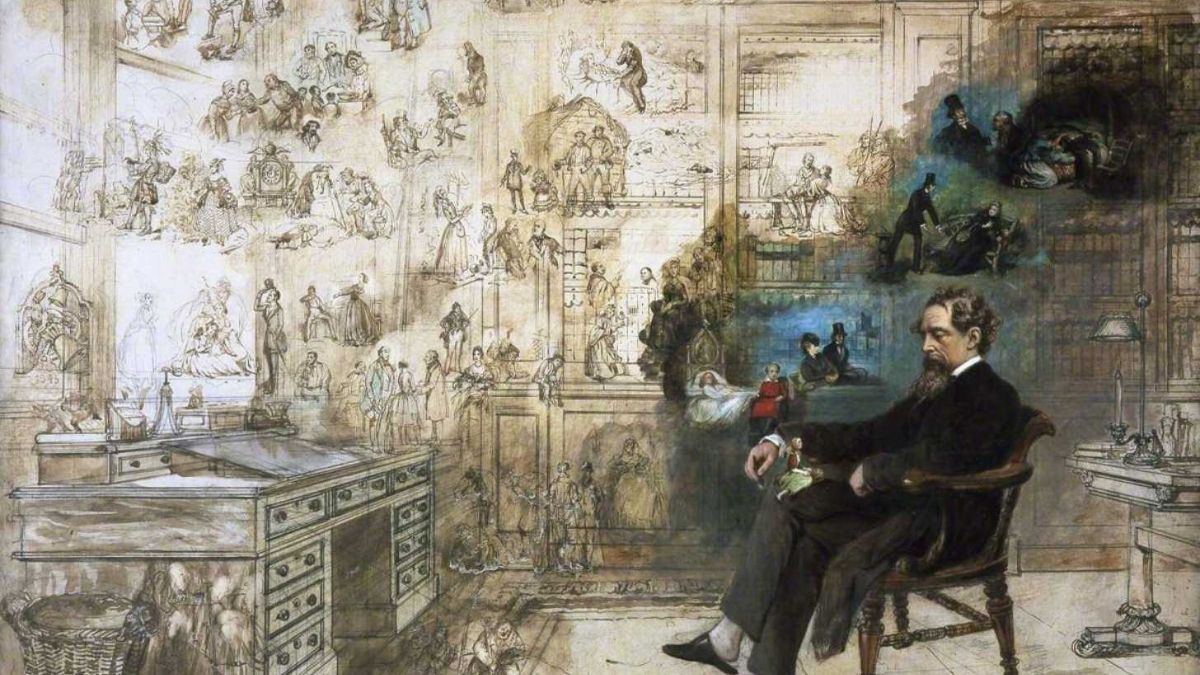
One of the most surprising findings in aphantasia research is that many people who can’t voluntarily form mental images still dream visually.
At first glance, that sounds contradictory. If someone lacks a mind’s eye while awake, how can their dreams contain scenes, faces, or movement? But this contrast turns out to be one of the most revealing clues about how imagination actually works in the brain.
The key distinction is between voluntary and involuntary imagery. Voluntary imagery is the deliberate act of calling up an image on demand, picturing a face, a place, or a scene at will. That’s the process that’s reduced or absent in aphantasia. Dreaming, by contrast, is automatic. Images arise without effort, intention, or conscious control.
This would appear to suggest that the brain’s capacity to generate images is still there. What’s different is access. A helpful way of putting it is that the projector works, but the remote doesn’t. During sleep, imagery is generated bottom-up, without the need for conscious instruction. During waking life, when imagery depends on top-down control, that pathway seems to be less accessible.
This helps explain why many people with aphantasia report vivid dreams despite an absence of imagery when reading, remembering, or planning. It also challenges a simple idea that imagination lives or dies as a single ability. Instead, it suggests that imagery depends on multiple systems, some under conscious control, others running on their own.
The dream paradox doesn’t just add an intriguing twist. It quietly reframes the whole topic. Aphantasia isn’t about a missing mental faculty. It’s about how, when, and under what conditions the brain turns thought into image.
A Difference Worth Noticing
If this article has done anything, I hope it has made one thing clearer than before: much of our inner life goes unquestioned simply because it feels ordinary.
Reading, imagining, remembering, and dreaming all seem effortless from the inside. But as aphantasia shows, the mental tools we use to do these things aren’t as uniform as we tend to assume. For some people, words effortlessly give rise to images. For others, meaning arrives without pictures at all.
This is part of what makes aphantasia such a compelling topic. It sits at the intersection of imagination, consciousness, memory, and language. It raises fundamental questions about how inner experience is constructed, how much it varies, and how rarely we compare notes. For students of psychology, it’s a rich area for further study and would make an excellent topic for a research project or final-year dissertation.
If You Enjoyed This Article…
I’m very happy to share that my new book, Why We Are the Way We Are: Psychology for the Curious, is now available on Amazon in both paperback and eBook format.
📘 Paperback: www.amazon.com/Why-We-Are-Way-Psychology/dp/B0G4D1WJCW
📱 Kindle eBook: www.amazon.com/Why-We-Are-Way-Psychology-ebook/dp/B0G4BGR9T3
The book is a carefully curated collection of the most popular articles from this website and my Psychology Substack. If you’ve enjoyed this piece and the exploration of why we think, feel, and behave the way we do, the book brings these ideas together in one place. It also makes a thoughtful gift for anyone who loves psychology or is simply curious about what makes us tick.
If you do pick up a copy, I’d be incredibly grateful if you could leave a rating or review on Amazon. Even a short line makes a real difference. Reviews help raise the profile of the book and allow more people to discover it.
Any profit from sales goes directly toward the hosting and running costs of the All About Psychology website, which helps ensure that:
- Students and educators can continue accessing the most important and influential journal articles in psychology completely free.
- Readers everywhere can hear directly from world-class psychologists and leading experts.
- High-quality psychology content remains freely available to the public.
Thank you, as always, for reading, supporting, and being part of this community. It’s very much appreciated.
All the very best,
David Webb
Founder, All-About-Psychology.com
Author | Psychology Educator | Psychology Content Marketing Specialist

Know someone who’d enjoy reading this?
Share this page with them.
Go From “When Reading Doesn’t Look the Same for Everyone” Back To The Home Page