Thinking About Studying Psychology Online?
Explore online psychology degree options, including program types, accreditation, costs, career pathways and what to check before choosing a course.
Read The Online Psychology Degree Guide
Passive-Aggressive Behavior: When Hostility Hides in Plain Sight
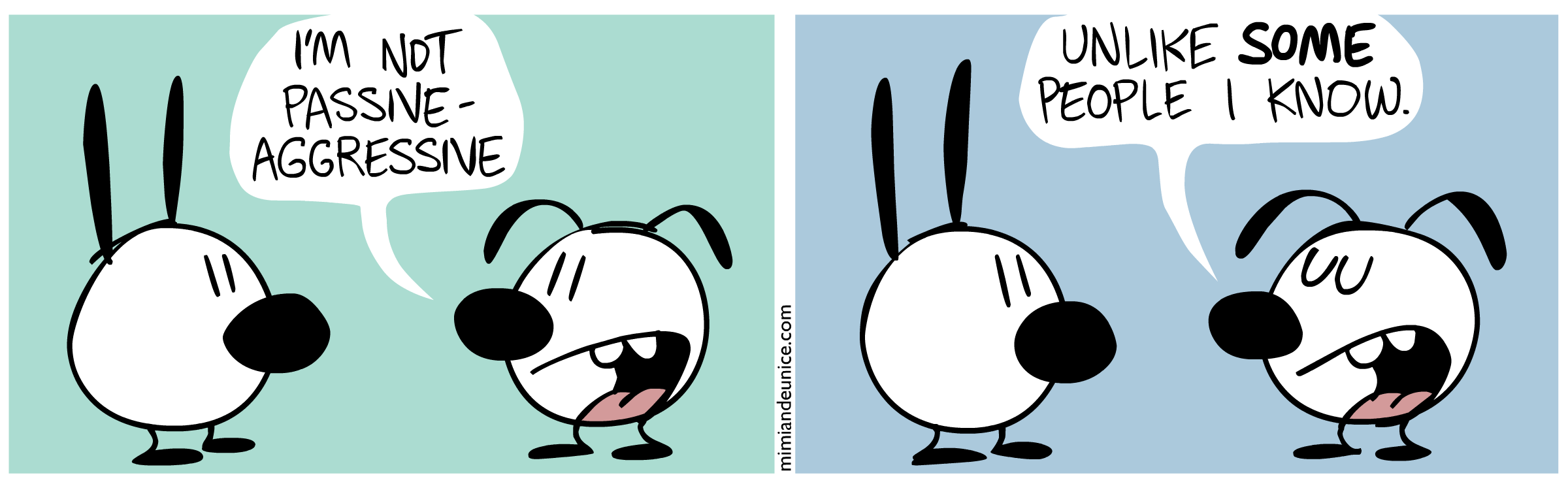 Cartoon by Nina Paley via mimiandeunice.com
David Webb (Founder and Editor of All-About-Psychology.com)
I recently came across a test on the Psychology Today website that asks a deceptively simple question: “Could you be passive-aggressive?” According to the description, passive-aggressive behavior involves expressing frustration, irritation, or resentment indirectly rather than addressing it openly, often in ways that strain relationships, even with people we’re close to. In some cases, that hostility isn’t aimed outward at all, but turned inward instead.
Apparently, I fall somewhere in the moderately passive-aggressive range, which probably explains why, on seeing the result, my inner voice said, “Good to know a handful of multiple-choice questions know me so well.” 😂
Joking aside, I enjoyed the test because it nudged me to look more closely at a pattern most of us recognise but rarely stop to examine. Passive-aggressive behavior is easy to dismiss as trivial or irritating, yet it plays a surprisingly powerful role in how conflict, resentment, and control show up in everyday life. That’s exactly what I want to explore in this article.
Clinicians who treat anger tend to see passive aggression from the other side of the same coin. "When someone learns early that open anger isn't safe to show, the frustration doesn't vanish - it goes underground and leaks out sideways as delay, silence, or veiled hostility," says Rod Mitchell, a Registered Psychologist and founder of Emotions Therapy Calgary, a counselling practice that specializes in anger management. "The work is usually less about controlling the outbursts and more about giving that buried frustration a direct, regulated way out."
A Brief History of Passive-Aggressive Behavior
Passive-aggressive behavior didn’t start life as a casual label for everyday irritation. Its roots lie in a much narrower and more revealing context.
The term was first used during the Second World War, when military psychiatrists began to notice a curious pattern among some soldiers. These individuals weren’t openly insubordinate. They technically followed orders. Yet they repeatedly failed to carry them out effectively, through chronic delay, inefficiency, forgetfulness, or subtle obstruction. Compliance existed on paper, but resistance was quietly built into the execution.
In a military setting, this mattered. Discipline relies on clear, timely obedience, and this kind of indirect resistance undermined authority without ever challenging it directly. That tension between surface cooperation and concealed defiance stood out as psychologically distinctive, enough to warrant formal attention and a name.
After the war, clinicians started to recognise the same pattern outside the armed forces. It appeared in offices, families, and intimate relationships. The environment had changed, but the underlying structure had not. Frustration and resentment were still being expressed indirectly, rather than confronted head-on.
As the concept expanded, it came to include far more than missed deadlines or procrastination. Passive-aggressive behavior began to encompass chronic sulking, stubborn resistance, hostility toward authority, and a recurring sense of being misunderstood or unfairly treated. Crucially, it was no longer seen as a one-off reaction, but as a recurring style of coping with frustration and power.
As psychiatric thinking evolved, so too did the classification of this pattern. Across multiple editions of diagnostic manuals, passive-aggressive behavior was repeatedly reframed, renamed, and reassessed, reflecting ongoing uncertainty about how best to understand it.
Is Passive-Aggressive Behavior a Disorder?
This uncertainty leads to a central question: should passive-aggressive behavior be understood as a mental disorder, or simply as an aggravating way some people manage conflict?
The answer depends largely on frequency and pattern. Most people avoid confrontation from time to time. Most of us express irritation indirectly on occasion. Isolated moments like these aren’t pathological.
Historically, concern only arose when passive-aggressive behavior became entrenched. When indirect resistance turned into a default response across work, relationships, and daily responsibilities, the consequences became harder to ignore. Trust weakened. Conflict lingered without resolution. Resentment accumulated on both sides.
Part of the controversy surrounding diagnosis stemmed from the fact that passive-aggressive behavior often appears context-dependent. It can emerge in environments where people feel controlled, powerless, or unable to speak freely. Critics worried that labeling such responses as disordered risked turning understandable reactions into medical problems.
At the same time, clinicians noticed something else. For some individuals, the behavior didn’t fade when circumstances improved. Even in safer relationships or fairer environments, the same pattern reappeared. Expectations, criticism, and authority continued to trigger indirect resistance, suggesting something more stable was at play.
Today, passive-aggressive personality disorder no longer exists as a standalone diagnosis. Instead, the traits once associated with it have been absorbed into broader personality dimensions, including hostility, oppositional tendencies, and negative emotionality. This change reflects a move away from rigid categories, not a dismissal of the behavior’s psychological significance.
In practical terms, passive-aggressive behavior may no longer carry a diagnostic label, but it remains a valuable concept. It describes a distinctive way frustration, resentment, and resistance can be expressed when direct confrontation feels unsafe, risky, or emotionally threatening. Understanding that pattern often matters far more than debating what to call it.
What Passive-Aggressive Behavior Looks Like in Everyday Life
Before getting into the specific forms this behavior takes, this Saturday Night Live sketch captures the tone and dynamic of passive aggression in a way that’s both amusing and unsettling.
This helps explain why passive aggression is so often described as sugarcoated hostility. The irritation, contempt, and quiet nastiness are genuine, even when they’re wrapped in politeness or delivered with a smile. It’s that mismatch between tone and intent that makes passive-aggressive behavior both hard to pin down and quietly damaging.
In day-to-day life, passive-aggressive behavior tends to reveal itself less through what someone says than through what they do, or fail to do. On the surface, the language may sound cooperative, reasonable, even friendly. Beneath that surface, resistance is doing the real work.
One of the clearest expressions of this is withdrawal. Communication shuts down. Eye contact disappears. Conversations end abruptly or never start at all. In close relationships, this can slide into stonewalling or sudden emotional distance. Nothing is said outright, yet the message lands clearly: access has been revoked.
Another familiar pattern is verbal ambiguity. Sarcasm, backhanded praise, and “jokes” that sting allow hostility to be expressed without being owned. When challenged, the response is often deflection: “I was only joking,” or “you’re taking it too seriously.” Even phrases like “I’m fine” or “I’m not angry” can function passively aggressively when tone, posture, or behavior signal the opposite.
There’s also deliberate underperformance, sometimes referred to as weaponized incompetence. A request is technically accepted, but carried out so poorly, slowly, or incorrectly that it becomes pointless. The surface appearance is cooperation. The outcome is obstruction.
Closely linked to this is procrastination and selective forgetting. Commitments are agreed to, then quietly delayed. Deadlines slip. Appointments vanish from memory. Each instance can be explained away on its own, but over time the pattern leaves others feeling undermined, stalled, or taken lightly.
When these behaviors repeat, they often intensify. What begins as mild resistance can escalate into more consequential acts. Someone may notice a problem developing and deliberately choose not to intervene. At more extreme levels, the behavior becomes covertly retaliatory, carried out through anonymous sabotage or quiet revenge. In its most destructive form, the aggression turns inward, with self-sabotage used as a way to punish or shame others.
Psychological research has also drawn attention to a particularly elusive pattern known as aggression by omission. Rather than acting harmfully, the person withholds something that would prevent harm or provide support. Information isn’t shared. Effort isn’t acknowledged. Help isn’t offered at the moment it’s most needed. Nothing overt happens, yet the consequences are real and often deliberate.
Across all of these forms, a recognisable interpersonal rhythm tends to emerge. The person behaving passively aggressively often appears calm, composed, and reasonable. Meanwhile, their behavior steadily provokes frustration in others. When that frustration finally surfaces as anger or emotional expression, the focus shifts. The reaction becomes the problem. The original behavior fades into the background.
A useful metaphor is a dripping tap. One drip is easy to ignore. Over time, the steady repetition causes damage that’s harder to repair. Relationships rarely collapse because of a single sarcastic remark or missed deadline. They wear down through the slow accumulation of small, unresolved acts of resistance.
Seen this way, passive-aggressive behavior isn’t defined by isolated moments. It’s defined by repetition. Agreeable words paired with obstructive behavior, repeated often enough to shape how conflict unfolds and how trust erodes.
Why Some People Rely on Passive-Aggressive Behavior
Passive-aggressive behavior endures because it serves a purpose. For the person using it, it offers a way to manage conflict, protect self-image, and express hostility without facing the risks of direct confrontation.
For many, these patterns take root early. Growing up in environments where anger was punished, minimised, or met with disproportionate reactions teaches a clear lesson: direct expression isn’t safe. Children in these settings often learn to suppress frustration and release it indirectly through delay, withdrawal, or quiet defiance. When speaking openly leads to criticism or loss of connection, indirect resistance feels safer.
Parenting style plays a role here. Highly controlling, neglectful, or inconsistent caregiving can leave children feeling perpetually wrong or unseen. When appreciation is scarce and expectations are rigid, asserting oneself openly may feel pointless or dangerous. Over time, resistance goes underground. Compliance remains on the surface, but resentment shapes behavior.
These patterns are also learned through observation. Children absorb how the adults around them handle disagreement. If sarcasm, silence, or martyrdom are the primary tools on display, those strategies become normalised. Add trauma, neglect, or chronic instability, and indirect coping may feel like the only available option.
On a psychological level, passive aggression often functions as a form of self-protection. Direct anger requires exposure. It risks rejection, escalation, or loss. For people who fear conflict or abandonment, indirect hostility offers a compromise. The feeling is expressed, but responsibility remains hidden. This is especially common among individuals with insecure attachment styles, where stating needs feels synonymous with being “too much.”
Self-esteem also matters. When people doubt their own worth, direct assertion can feel undeserved or presumptuous. Passive aggression provides a way to reclaim control without openly claiming it. The reward doesn’t come from resolution, but from quietly disrupting expectations.
Emotional skill plays a role too. Some people struggle to identify what they’re feeling, let alone put it into words. If you’ve learned that you’re supposed to be agreeable, calm, or endlessly resilient, negative emotions still surface. When they can’t be named, they act themselves out.
Context matters as well. Passive-aggressive behavior often flourishes in unequal power relationships. When direct confrontation carries consequences, subtle resistance becomes a way to restore agency. This is why passive aggression is so common in settings where overt anger is discouraged but resentment is widespread.
It’s also important not to over-sanitise the explanation. Not all passive aggression is driven by fear or vulnerability. For some, the indirectness is the appeal. It allows contempt without accountability, belittlement without consequences, and control without exposure. Ambiguity becomes a shield.
Biology and mental health can intersect here too. Passive-aggressive patterns often overlap with depression, anxiety, and certain personality traits. In some cases, the aggression turns inward, expressed through self-denial or self-sabotage rather than outward conflict.
What connects all of this is function. Passive-aggressive behavior isn’t random. It’s a strategy, learned or reinforced over time, that balances expression and avoidance. It allows someone to appear cooperative while acting resistant, to feel morally intact while still inflicting damage.
Understanding why people rely on it doesn’t excuse the harm it causes. But it does explain why the pattern can be stubbornly persistent, and why simply urging someone to “be more direct” rarely works on its own.
Responding to Passive-Aggressive Behavior
Once you start noticing passive-aggressive behavior, the real challenge isn’t spotting it. It’s resisting the urge to respond in kind.
Passive aggression feeds on reaction. Silence, sarcasm, or inefficiency often function, consciously or not, as bait. When frustration finally spills over, the narrative flips. The passive-aggressive person appears calm and reasonable. The person reacting looks emotional or unreasonable. The original behavior slips out of focus.
Breaking that cycle starts with refusal. Silence doesn’t need to be met with silence. Sarcasm doesn’t need to be returned. Over-functioning to compensate only reinforces the pattern. Remaining calm isn’t about submission. It’s about preserving enough clarity to address what’s actually happening.
One helpful approach is benign confrontation. Instead of accusing or escalating, the goal is to describe what you’re noticing and gently point toward the emotional layer beneath it. Phrases like, “I’m wondering if that request was frustrating,” or “I noticed you didn’t respond, and I’m trying to understand why,” shift attention away from the surface behavior without provoking defensiveness.
Denial is common. Passive aggression relies on plausible innocence, so responses like “I’m fine” or “you’re overthinking it” are to be expected. The aim isn’t to force admission. It’s to introduce awareness. When the pattern repeats, you can return to it calmly, helping make it visible without turning the interaction into a power struggle.
Clarity also reduces room for maneuver. Clear expectations, boundaries, and consequences make it harder for resistance to hide. This is especially relevant in professional settings, where outcomes matter more than intentions. Focusing on results rather than reassurances limits ambiguity.
Direct communication helps too. Passive aggression thrives in emails and indirect messages, where tone is obscured and responsibility diffused. Real-time conversations reduce that cover. When veiled comments appear, calmly asking for clarification often brings things back into the open.
Managing your own response is just as important. Passive-aggressive dynamics often pull others into compensating, smoothing over problems, or carrying extra weight. While this keeps things moving, it usually strengthens the pattern. Allowing natural consequences can feel uncomfortable, but it may be necessary.
When change isn’t forthcoming, emotional disengagement can be protective. Becoming less reactive and less invested in extracting accountability deprives the behavior of its payoff. This isn’t about withdrawal, but about conserving energy where it’s being drained.
Responding effectively to passive aggression isn’t about clever tactics. It’s about refusing ambiguity, staying grounded in what you observe, and addressing behavior without surrendering your own composure.
When Passive-Aggressive Behavior Is Your Own
If parts of this article felt uncomfortably familiar, that recognition matters. Passive-aggressive behavior isn’t a fixed flaw. It’s usually a learned response to discomfort, and learned patterns can be unlearned.
At its core, passive aggression reflects a gap between feeling and expression. Frustration, resentment, insecurity, or dissatisfaction are present, but instead of being stated, they seep out indirectly. Change begins when that gap becomes visible.
This starts with awareness. Passive-aggressive behavior often feels reasonable in the moment and invisible from the inside. Sarcasm feels light. Silence feels protective. Delay feels justified. Paying attention to your own patterns is essential. Notice when you say yes while meaning no. Notice when irritation shows up as avoidance rather than words.
The body often signals trouble first. Suppressed emotion doesn’t disappear. It shows up as tension, shallow breathing, or irritation that feels out of proportion. Learning to recognise these cues creates space to choose a different response.
It also helps to ask what the behavior is shielding you from. Passive aggression is rarely about the surface issue. It’s usually about an unmet need or a belief learned long ago. Perhaps anger once led to rejection. Perhaps authority feels unsafe. When those beliefs go unquestioned, indirect resistance feels necessary.
The alternative isn’t aggression. It’s assertiveness. That means stating needs clearly, without hostility or apology. It means abandoning the hope that others should intuit what you want. Unspoken expectations are fertile ground for resentment.
Directness often feels riskier at first, especially if avoidance has been your default. But it’s also cleaner. Saying “I feel frustrated when this happens” gives the other person something concrete to respond to. Saying yes while planning to resist later only deepens the pattern.
Learning to manage the moment matters too. The urge to withdraw, delay, or make a cutting remark often arrives quickly. Pausing, breathing, and regulating that surge interrupts the automatic response. Sometimes doing the opposite helps. If withdrawal is the impulse, engage gently. If punishment is the urge, speak calmly.
Over time, this requires rethinking conflict itself. Avoidance may feel protective, but it slowly corrodes trust. Respectful disagreement strengthens relationships. Passive aggression weakens them. Saying no upfront is almost always kinder than agreeing and resenting later.
When these patterns feel deeply ingrained, professional support can help. Approaches that focus on emotional regulation and communication skills address both inner experience and outward behavior. The aim isn’t to eliminate difficult feelings, but to express them without disguise or damage.
Letting go of passive-aggressive behavior means relinquishing the safety of ambiguity. In exchange, you gain clarity, self-respect, and relationships that aren’t quietly worn down by what goes unsaid.
Final Thoughts
Passive-aggressive behavior becomes hard to ignore once you start seeing it. Part of the discomfort comes from the space it occupies between intention and denial. Something is being communicated, but never fully owned.
What makes it so corrosive isn’t just the behavior itself, but the uncertainty it creates. When frustration, resentment, or contempt are expressed indirectly, people don’t know what they’re responding to. Over time, that uncertainty carries a cost.
One unsettling realisation is how ordinary passive aggression is. It doesn’t require a diagnosis or a dramatic history. It shows up in everyday moments: unanswered emails, delayed tasks, jokes that sting, silences that linger. Once you notice it, you start to see how often it substitutes for saying something difficult out loud.
It’s tempting to treat passive aggression as a problem other people have. Yet part of its persistence lies in how easily it slips into our own habits, especially when we’re tired, irritated, or avoiding conflict. That doesn’t make it inevitable, but it does make it human.
Directness asks more of us. It requires tolerating discomfort, risking misunderstanding, and accepting that we won’t always get the response we want. What it offers in return is clarity. And with clarity comes the possibility of repair, change, and relationships that aren’t quietly eroded by what goes unsaid.
If this article has done anything, I hope it’s made passive-aggressive behavior easier to recognise, in others and in yourself. Not as a label to wield, but as a signal that something needs to be expressed more honestly.
If You Enjoyed This Article…
I’m very happy to share that my new book, Why We Are the Way We Are: Psychology for the Curious, is now available on Amazon in both paperback and eBook format.
📘 Paperback: www.amazon.com/Why-We-Are-Way-Psychology/dp/B0G4D1WJCW
📱 Kindle eBook: www.amazon.com/Why-We-Are-Way-Psychology-ebook/dp/B0G4BGR9T3
The book is a carefully curated collection of the most popular articles from this website and my Psychology Substack. If you’ve enjoyed this piece and the exploration of why we think, feel, and behave the way we do, the book brings these ideas together in one place. It also makes a thoughtful gift for anyone who loves psychology or is simply curious about what makes us tick.
If you do pick up a copy, I’d be incredibly grateful if you could leave a rating or review on Amazon. Even a short line makes a real difference. Reviews help raise the profile of the book and allow more people to discover it.
Any profit from sales goes directly toward the hosting and running costs of the All About Psychology website, which helps ensure that:
- Students and educators can continue accessing the most important and influential journal articles in psychology completely free.
- Readers everywhere can hear directly from world-class psychologists and leading experts.
- High-quality psychology content remains freely available to the public.
Thank you, as always, for reading, supporting, and being part of this community. It’s very much appreciated.
All the very best,
David Webb
Founder, All-About-Psychology.com
Author | Psychology Educator | Psychology Content Marketing Specialist
