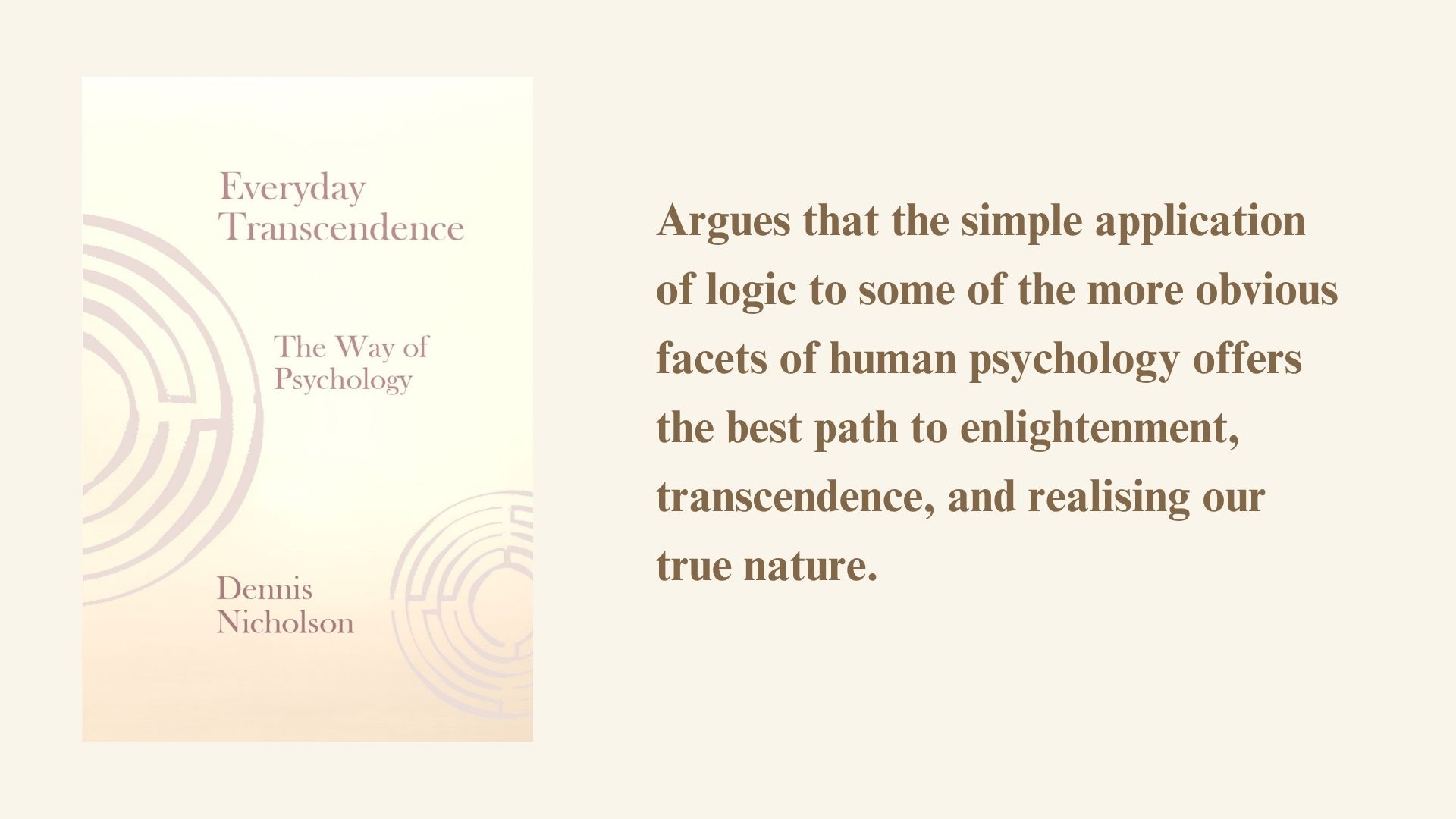
What if the simple application of logic to some of the more obvious facets of human psychology offers the best path to enlightenment, transcendence, and realising our true nature? What if it is also a key step in the development of a coherent science of experience and behaviour? This book offers support for both suggestions. A shorter, more accessible and informal follow-up to Nicholson's Self, Consciousness, and Being: The Transcendent Perspective, it presents a less complex presentation of the same basic case, offering new insights and clarifications and an easier read in the process.
The core argument is the same. We should use the mental exercises provided to replace the limited and restrictive self-views we acquire incidentally as we develop with the transcendent self-view – a perspective on the self that transcends ideas and viewpoints generally, seeing and treating them as subordinate facets of a total self that has empty consciousness, the underlying essence of consciousness itself, as its (arguably Zen-like) resting focus and core.
The result of adopting this self-view may be thought of as personal transcendence and even given a spiritual slant. However, it is best seen as an everyday kind of transcendence that is really nothing special – just a psycho-logically defensible and sensible endpoint to our inner development we should all arguably aspire to.
Everyday Transcendence: The Way of Psychology is available internationally from various sources, including Barnes & Noble, Blackwell's, Waterstone's, Booktopia, and Amazon:

 |
 |
 |
 |

Prefer another bookseller? You can also find Everyday Transcendence: The Way of Psychology via Books2Read.
About The Author

Dennis Nicholson is an independent researcher and author who dates his recognition of the likely value of an overarching perspective on the self to individuals and a coherent science of human experience and behaviour to what he characterises as 'episodes of reflective daydreaming' whilst attending Psychology and Logic and Philosophy of Science classes taken at Edinburgh University prior to graduating in 1973.
Employed at Strathclyde University in Glasgow in the decades that followed, most recently in a joint role as Director of Research in Information Services and research group leader (CDLR) in the Computer and Information Sciences Department, he retired early to focus fully on researching, developing and defending the notion of the generic human self-view he calls the transcendent perspective on the self.
A shorter, more informal follow-up to Nicholson's Self, Consciousness, and Being: The Transcendent Perspective (Nicholson, 2025), the book is an attempt to present the case in favour of the linked notions of everyday transcendence and the transcendent self-view in the simplest and most accessible way possible while also offering some additional clarifications and insights. A pared-down approach to the topic that can stand as a sufficient account in its own right but also provide an introduction to the longer work at a level acceptable to both busy academic readers and informed laypersons. The first two chapters and some supplementary material can be sampled here: https://doi.org/10.23668/psycharchives.22223

